

SONO Generations · Kids
Printable workbooks · Ages 3–10

Owning is taught at home.

Nobody hands an entrepreneur their business. No syllabus, no set deadlines, no instructor marking a grade at the end. Just a language of competence, acquired little by little through a continual process of trial and error. Each day in the life stacks failures as lessons until success becomes inevitable.

We built the SONO Generations: Builders curriculum to teach your children how to become well-versed in the language of real estate, starting with pronouncing “asset” at three and working towards calculating a mortgage on paper by ten.

Not yet on sale · the first four go out to the list

Instant PDF download · Print as often as you like · One licence per family

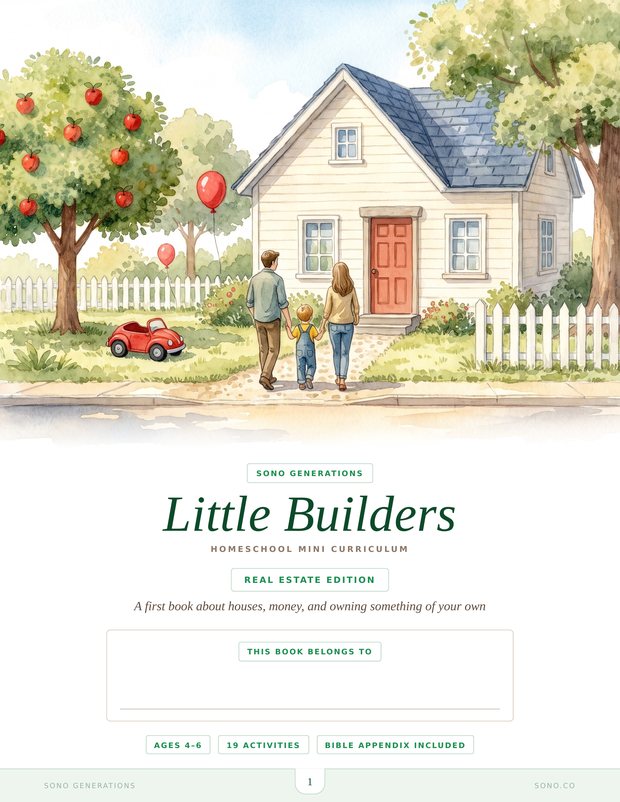
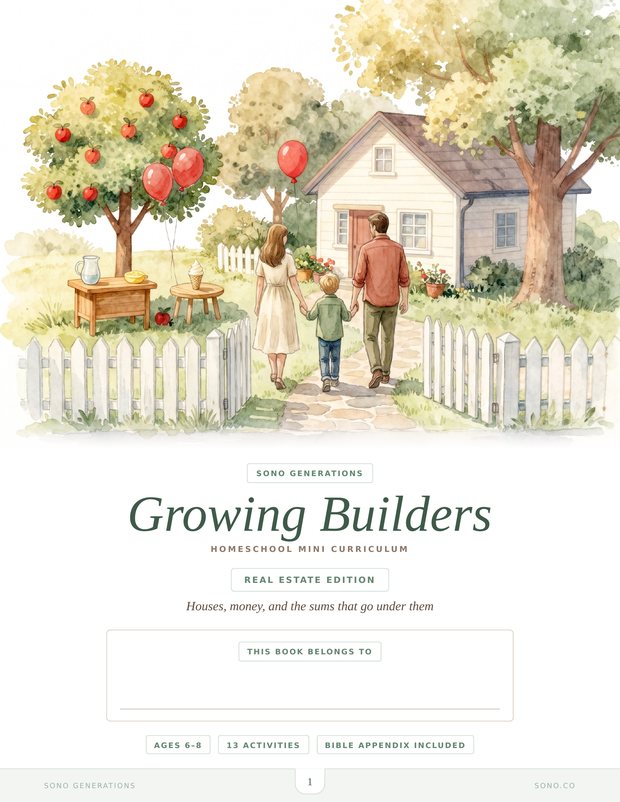
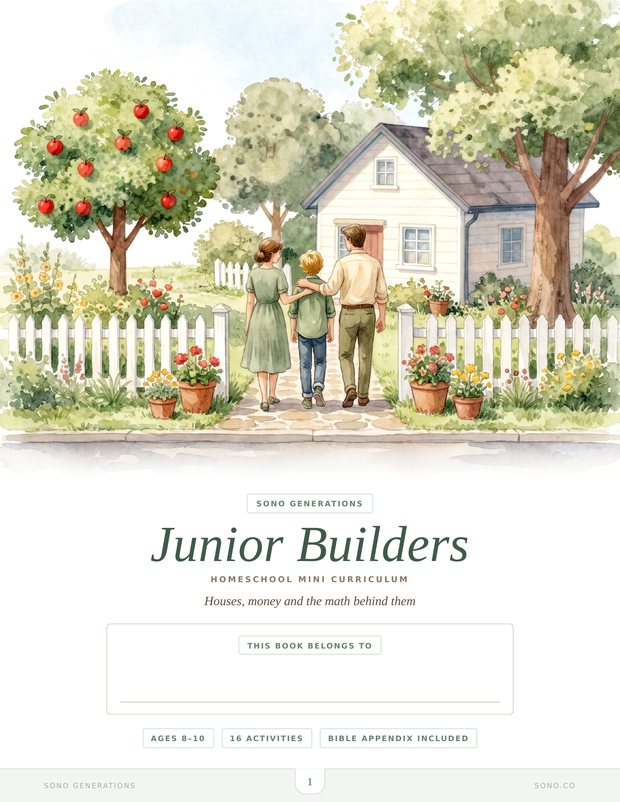
Cover of Tiny Builders, ages 3 to 4 Cover of Little Builders, ages 4 to 6 Cover of Growing Builders, ages 6 to 8 Cover of Junior Builders, ages 8 to 10
119 printed pages across four workbooks and a supplement
7 years of it, ages three to ten
10 ideas, taught four times over
0 screens involved
Watercolour of the same cottage in spring, summer, autumn and winter
Why we made these

School was never going to teach this.

Children pick up a language the way they pick up any language — early, out loud, and in stages. Asset at three, as a word to say. Mortgage at five, as something the house has. Equity at seven, as a sum they work out themselves. Amortisation at ten, in a budget of their own. The same vocabulary every year, rehearsed at whatever level the hand can manage, until it stops being a subject and becomes the way they look down a street. That is all these four workbooks are: seven years of rehearsal, so that the first time your child meets these words is at your kitchen table and not on a contract somebody is asking them to sign.

Every other money product

Spend. Save. Give.

  • Three jars on a shelf
  • A chore chart and an allowance
  • Coins named and counted
  • A quiz at the end of the unit

All of it useful. None of it ownership — it is the school unit on money with a cartoon on the cover, and it stops exactly where the interesting half starts.

What your child learns here

Ten ideas, three reading levels — six of them from age three.

  • What Is an Asset?
  • What Is a Loan?
  • What Is a Mortgage?
  • What Is Equity?
  • Rent or Own?
  • Needs, Wants and a Budget
  • Spend, Save, Invest
  • House Tour
  • Curb Appeal Detective

Investing is not the last chapter here — it is page seven.

Four printable workbooks · instant PDF download · not on sale yet

What's inside

The same lesson, at four different ages.

Read across a row, not down a column. School teaches a topic once, in the year it is assigned to, and moves on — a child who was not ready that year has simply missed it. Here the lesson never changes between the workbooks; only what a child is asked to do with it does. Every image is a page from the actual PDF, and every sentence in quotation marks is printed on the page above it.

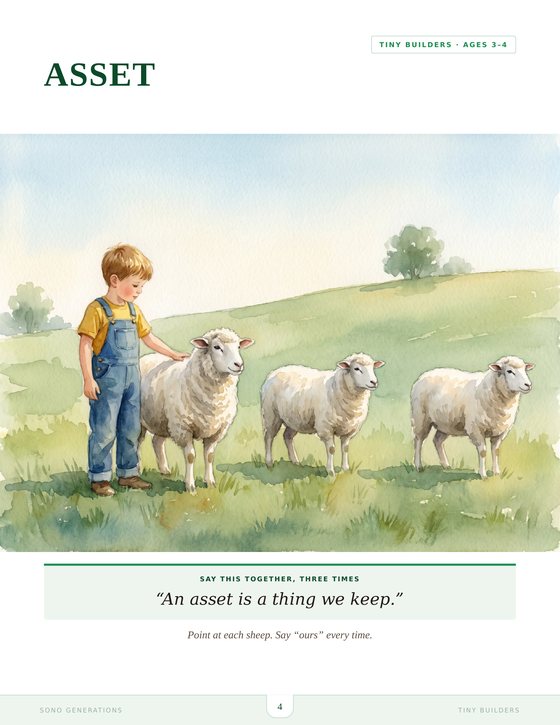
Asset

At three it is a thing you keep. At nine it is a thing that pays you.

Swipe to see all four ages →

The ASSET page from Tiny Builders, a watercolour of sheep in a field
Ages 3–4 An asset is a thing we keep. Point at each sheep. Say ours every time.
The What Is an Asset page from Little Builders
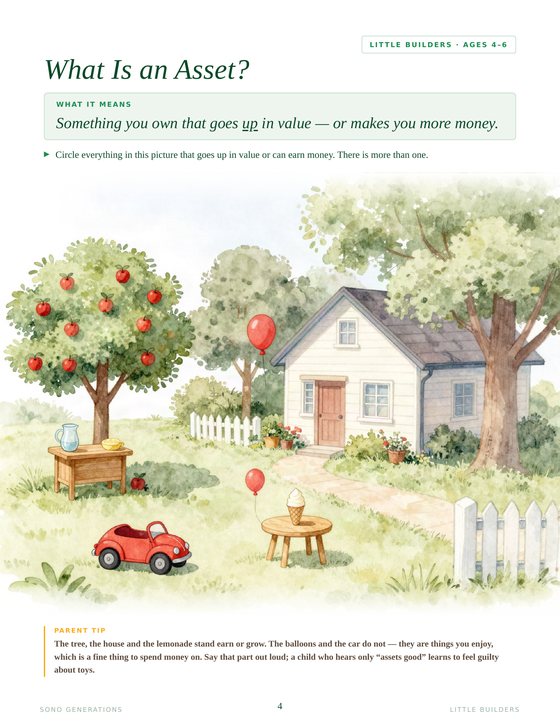
Ages 4–6 Something you own that goes up in value — or makes you more money. Circle everything in the picture that goes up in value or can earn money. There is more than one.
The What Is an Asset page from Growing Builders
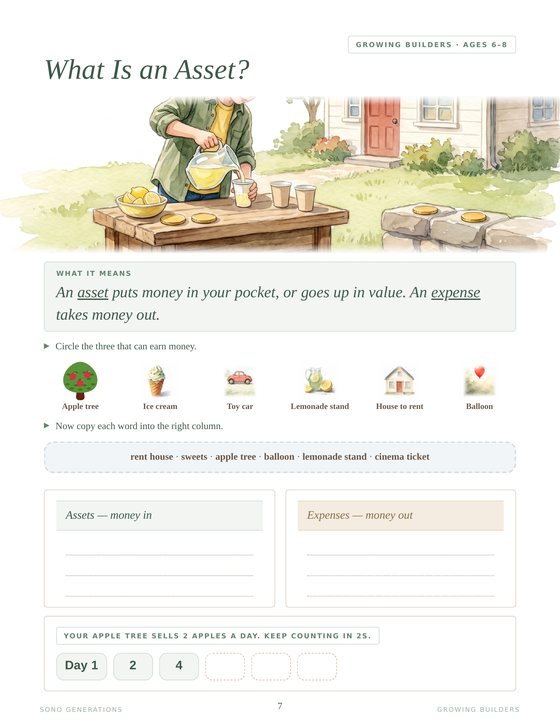
Ages 6–8 An asset puts money in your pocket, or goes up in value. An expense takes money out. Circle the three that can earn money. Then six words into two columns, and an apple tree's two-a-day counted on in 2s.
The Assets and Expenses page from Junior Builders
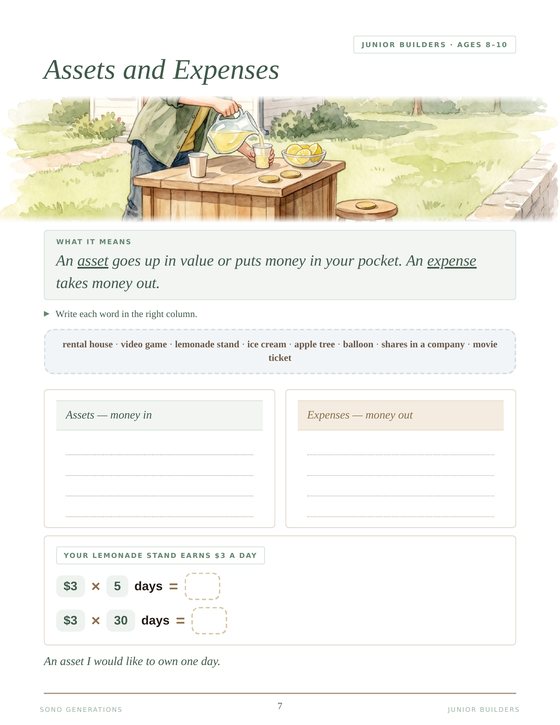
Ages 8–10 An asset goes up in value or puts money in your pocket. An expense takes money out. Eight words now, one of them shares in a company — then $3 a day multiplied out over 5 days and over 30.

Mortgage

Four words, then a sentence, then a small sum, then a bigger one.

Swipe to see all four ages →

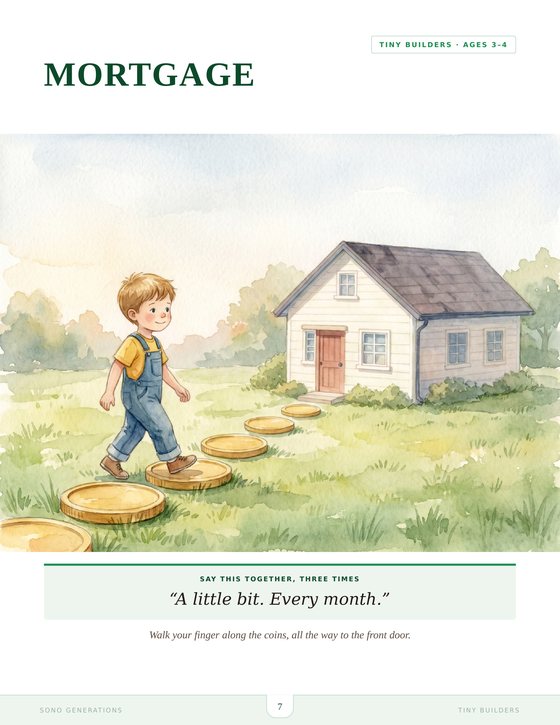
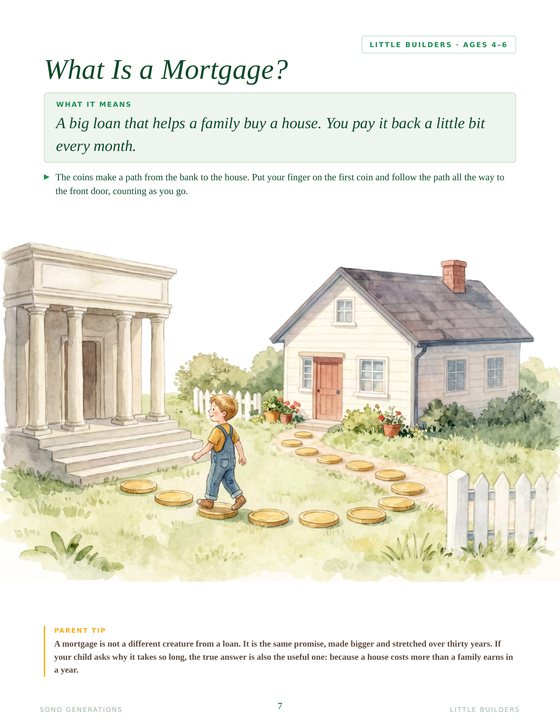
The MORTGAGE page from Tiny Builders, a watercolour of a boy following a path of coins to a house
Ages 3–4 A little bit. Every month. Walk a finger along the coins, all the way to the front door.
The What Is a Mortgage page from Little Builders
Ages 4–6 A big loan that helps a family buy a house. You pay it back a little bit every month. Follow the coin path from the bank to the house, counting out loud as you go.
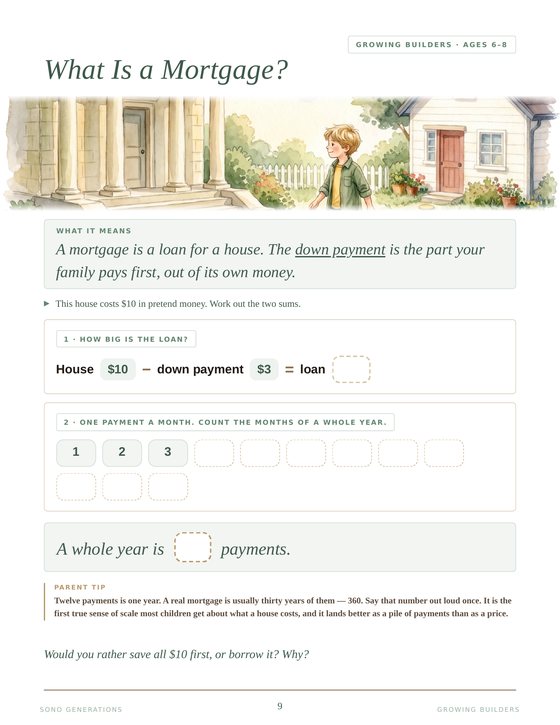
The What Is a Mortgage page from Growing Builders
Ages 6–8 A mortgage is a loan for a house. The down payment is the part your family pays first, out of its own money. A $10 house, $3 down: how big is the loan? Then count the months of a whole year, one payment each.
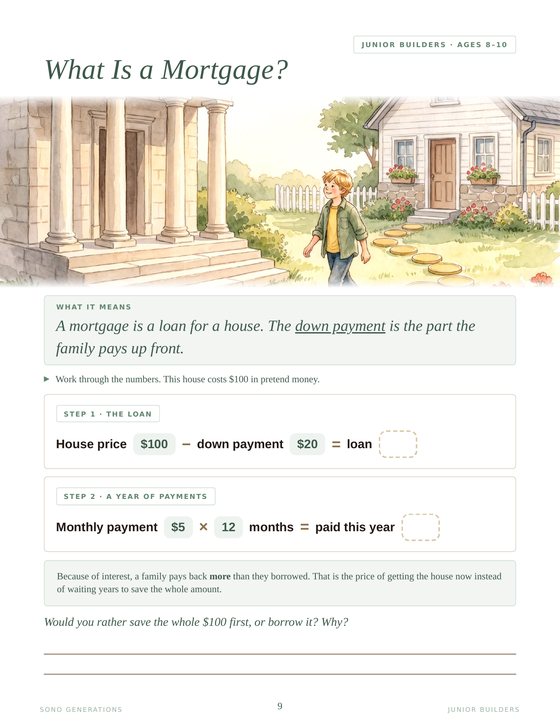
The What Is a Mortgage page from Junior Builders
Ages 8–10 A mortgage is a loan for a house. The down payment is the part the family pays up front. The same house at $100. $100 − $20 gives the loan; $5 × 12 gives the year. Both answers left blank.

Equity

The word most adults cannot define, arriving four times before ten.

Swipe to see all four ages →

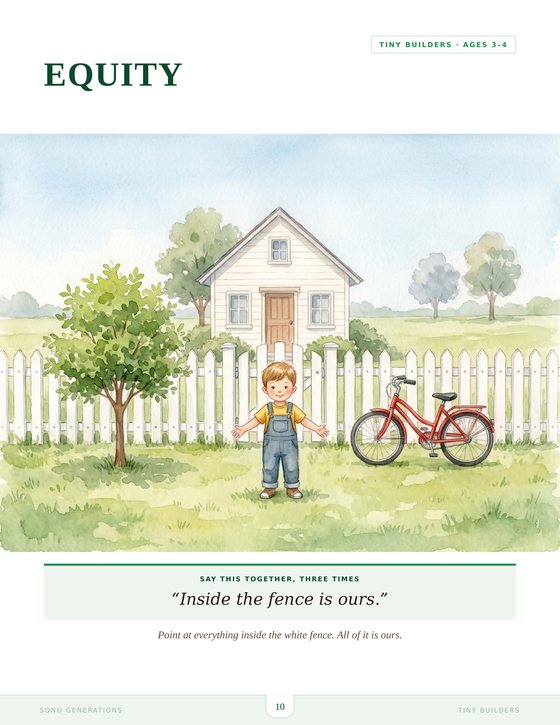
The EQUITY page from Tiny Builders, a watercolour of a house and garden behind a white fence
Ages 3–4 Inside the fence is ours. Point at everything inside the white fence. All of it is ours.
The What Is Equity page from Little Builders
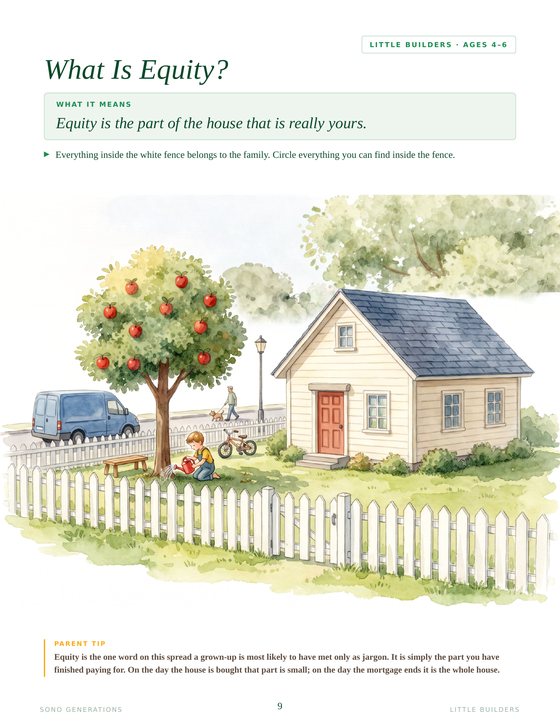
Ages 4–6 Equity is the part of the house that is really yours. Circle everything inside the white fence. That part belongs to the family.
The What Is Equity page from Growing Builders
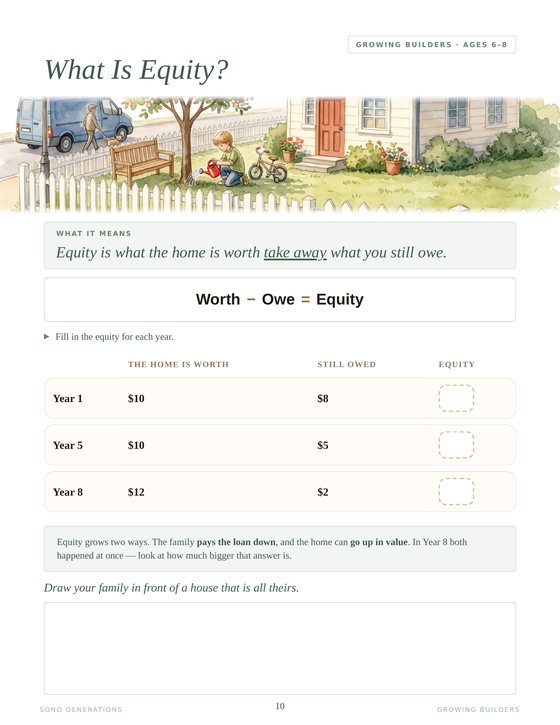
Ages 6–8 Equity is what the home is worth take away what you still owe. Worth − Owe = Equity, filled in for three years. Then: draw your family in front of a house that is all theirs.
The What Is Equity page from Junior Builders
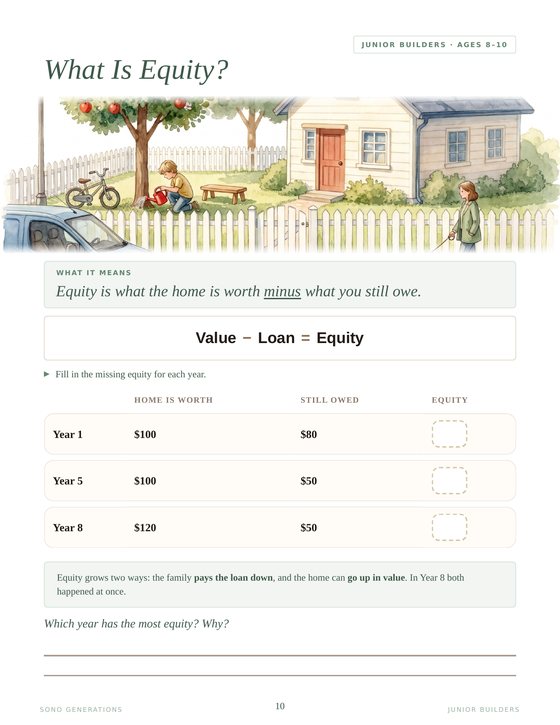
Ages 8–10 Equity is what the home is worth minus what you still owe. The same table, now Value − Loan = Equity — and a question underneath: which year has the most? Why?

The money meeting

The same table, the same day of the week, for seven years. By six the definition has stopped changing — read the last two across.

Swipe to see all four ages →

The Our Money Meeting page from Tiny Builders, a line drawing of a parent and child at a table, ready to colour
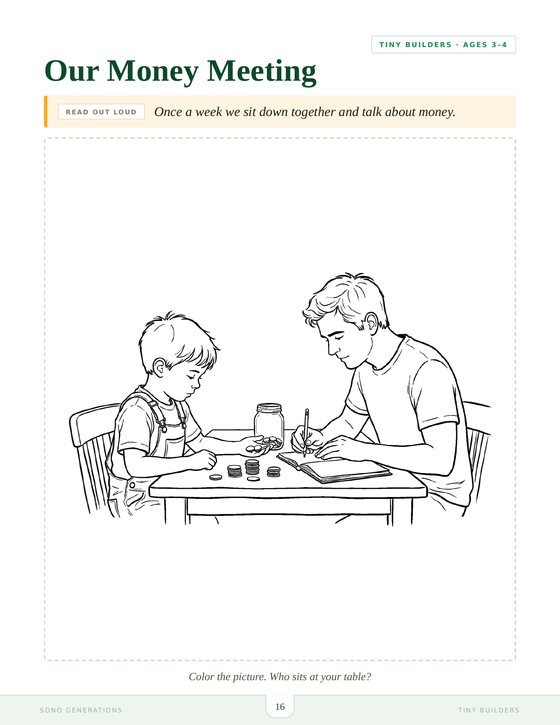
Ages 3–4 Once a week we sit down together and talk about money. Colour the picture. Who sits at your table?
The Our Money Meeting page from Little Builders
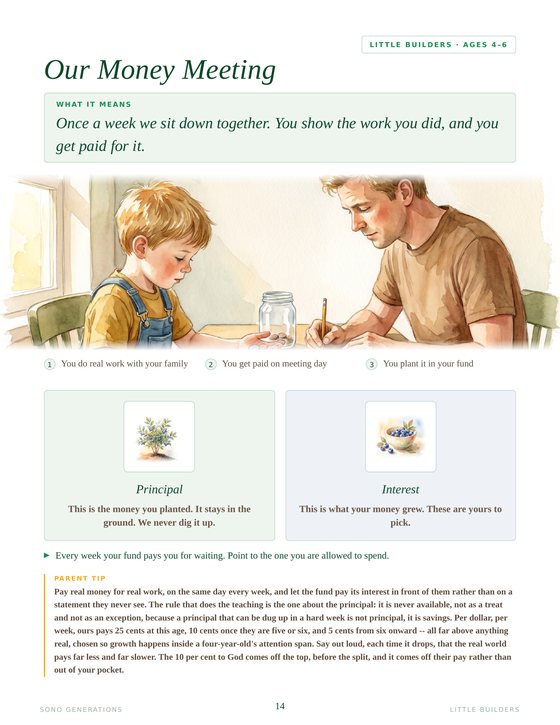
Ages 4–6 Once a week we sit down together. You show the work you did, and you get paid for it. Real work, paid on meeting day, then planted in a fund that pays them for waiting.
The Money Meeting page from Growing Builders
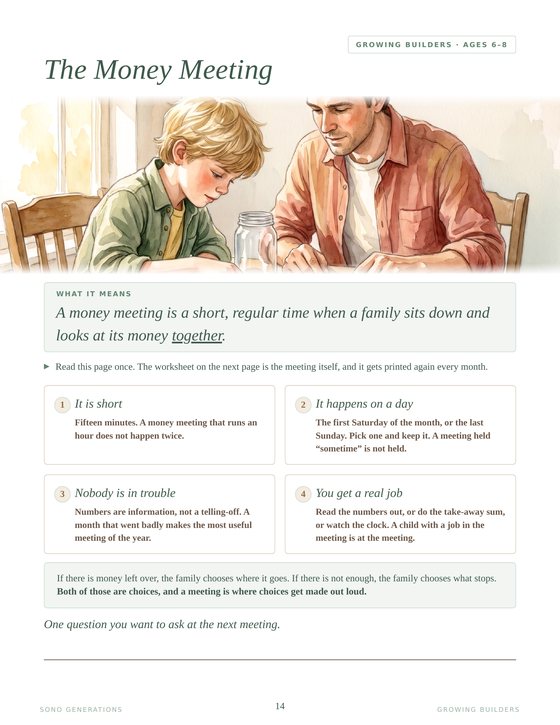
Ages 6–8 A money meeting is a short, regular time when a family sits down and looks at its money together. Fifteen minutes, on a day you pick and keep, and nobody is in trouble. If there is money left over, the family chooses where it goes.
The Money Meeting page from Junior Builders
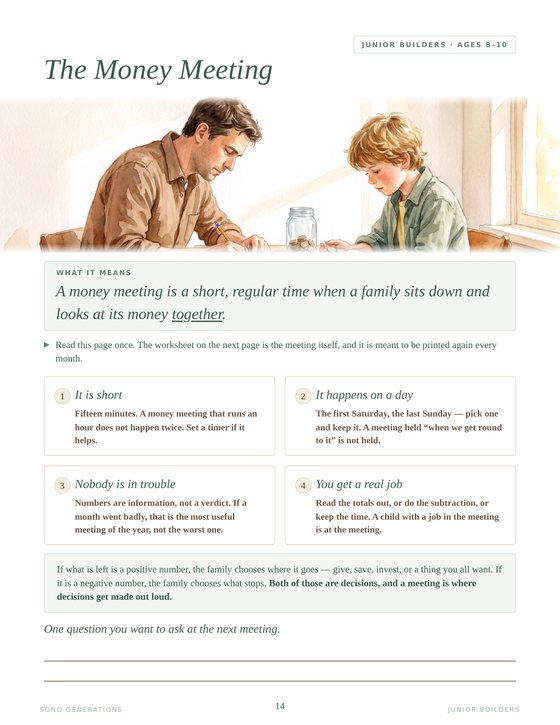
Ages 8–10 A money meeting is a short, regular time when a family sits down and looks at its money together. Word for word the same page — except that what is left over is now a positive or a negative number, and if it is negative the family chooses what stops.

Every page above is in the PDF you download · the list hears first

Where to teach it

An open house is a free field trip.

It is also the field trip no school is ever going to run. Class trips go to museums, where everything on display has already finished happening. An open house is the opposite of a museum: a six-figure asset with a price on it, standing open on a Saturday afternoon, free to walk through, and you are welcomed at the door for it. Whether property is your work or you are going deliberately to teach, two pages in these workbooks are built to be carried there on a clipboard.

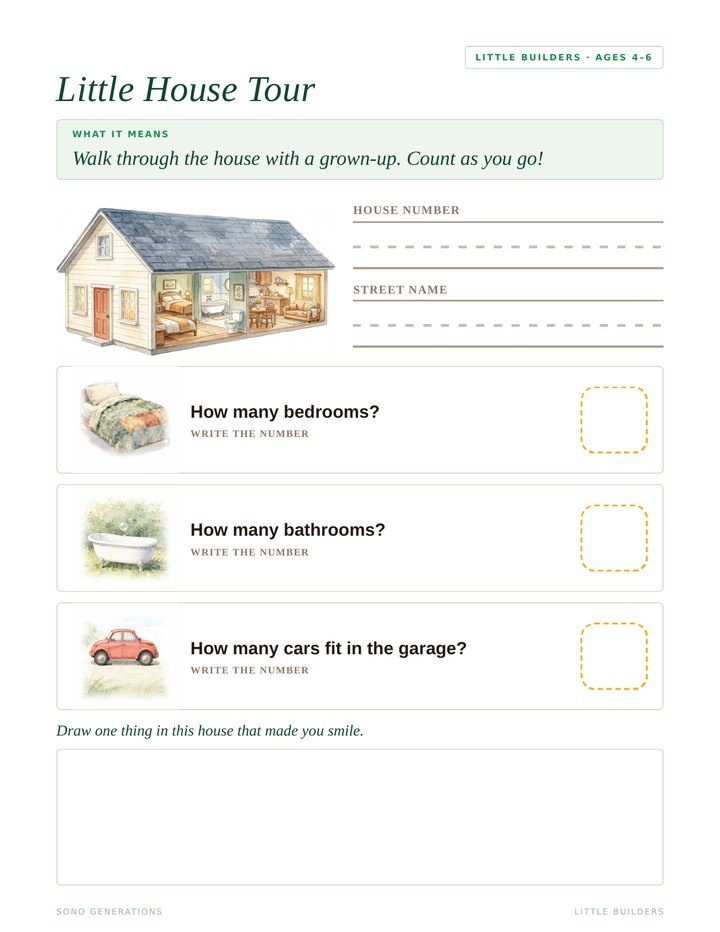
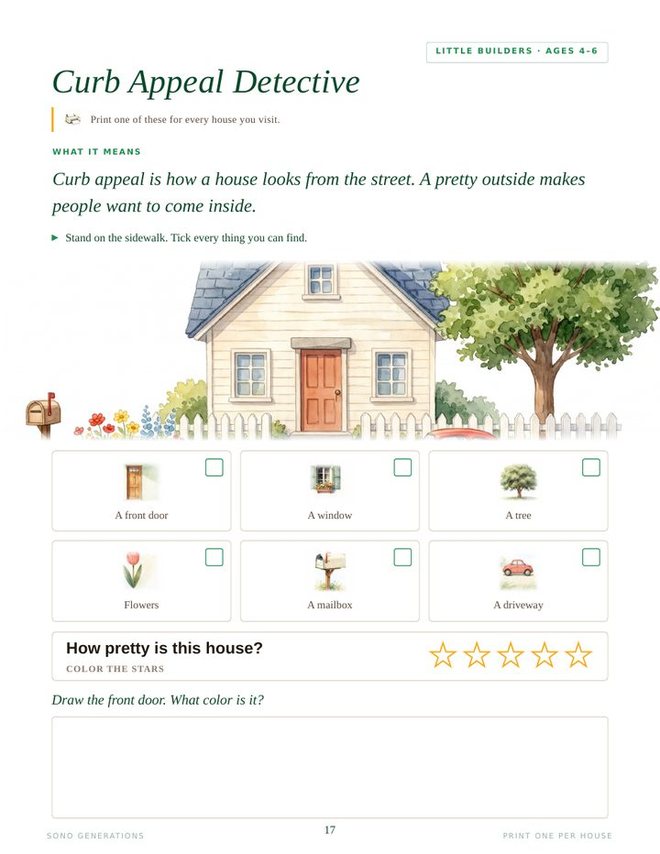
Little House Tour walks a child through a property counting bedrooms, bathrooms and garage spaces, and writing down the street name. Curb Appeal Detective asks them to stand at the kerb and work out why one house looks cared for and the one beside it does not.

Both are in Little, Growing and Junior Builders, pitched differently for each age. They are the pages that get printed four times and go missing in the footwell of the car, which is exactly what they are for.

The Little House Tour page, a worksheet for counting rooms at an open house The Curb Appeal Detective page
The free Little House Tour sample page
Free

Take one page to your next open house.

Little House Tour, the full page, free — the same file that is in the workbook, not a cut-down version of it. Print it, put it on a clipboard, and find out whether your child actually uses it before you spend anything.

One email with the PDF attached. Unsubscribe in a click.

The workbooks

Sorted by the hand, not the birthday.

A school year sorts children by the month they were born in. Pick instead by the one in front of you — what their hand can do, what they will sit still for — or take all four and grow into them. Each is an instant PDF download.

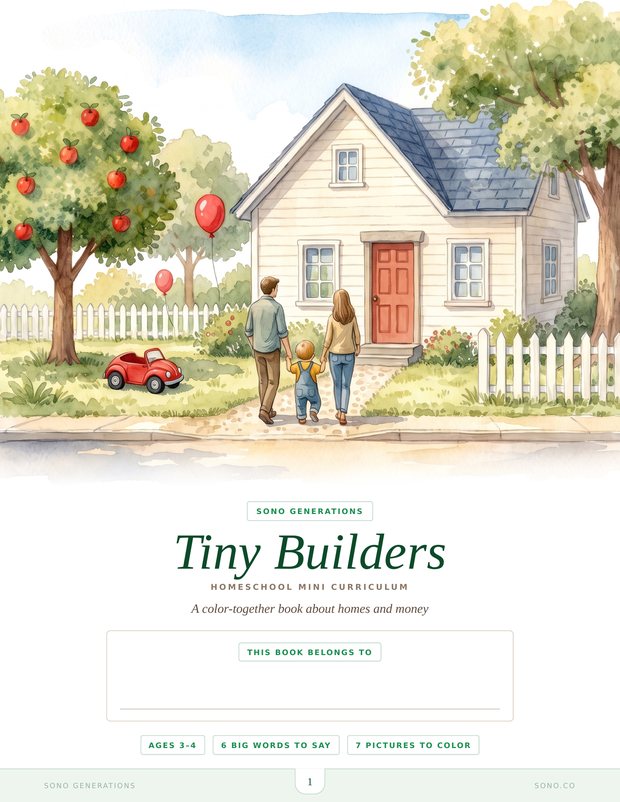
Tiny Builders cover

Ages 3–4

Tiny Builders

18 pages · six words to say, seven pictures to colour

  • Asset, loan, mortgage, equity, invest, generous — one word a spread
  • One sentence to say together three times, then a picture to colour
  • A jar of coins beside a berry bush — the whole idea, at three
  • A four-week money-meeting sheet for the fridge

Coming soon

Tell me first
Little Builders cover

Ages 4–6

Little Builders

28 pages · 19 activities + a 9-page appendix

  • Asset, loan, mortgage, equity, rent or own — each in a picture and one sentence
  • Circling, colouring, number tracing, counting to twelve
  • Little House Tour and Curb Appeal Detective, for real open houses
  • The Biblical Stewardship appendix included, six lessons, NKJV

Coming soon

Tell me first
Growing Builders cover

Ages 6–8

Growing Builders

26 pages · 13 activities + a 9-page appendix

  • One-step sums within 20, and skip-counting by 2s, 5s and 10s
  • A $10 house with $3 down — small enough to hold in your head
  • Worth − Owe = Equity, filled in for three years running
  • House Tour and Curb Appeal Detective, for real open houses
  • The Biblical Stewardship appendix included, seven lessons, NKJV

Coming soon

Tell me first
Junior Builders cover

Ages 8–10

Junior Builders

26 pages · 16 activities + a 9-page appendix

  • Percentages, multiplication and subtraction on real figures
  • A mortgage broken into a loan, a down payment and a year of payments
  • A budget with needs, wants and a line for investing
  • Design Your Dream House, drawn and then costed
  • The Biblical Stewardship appendix included, seven lessons, NKJV

Coming soon

Tell me first
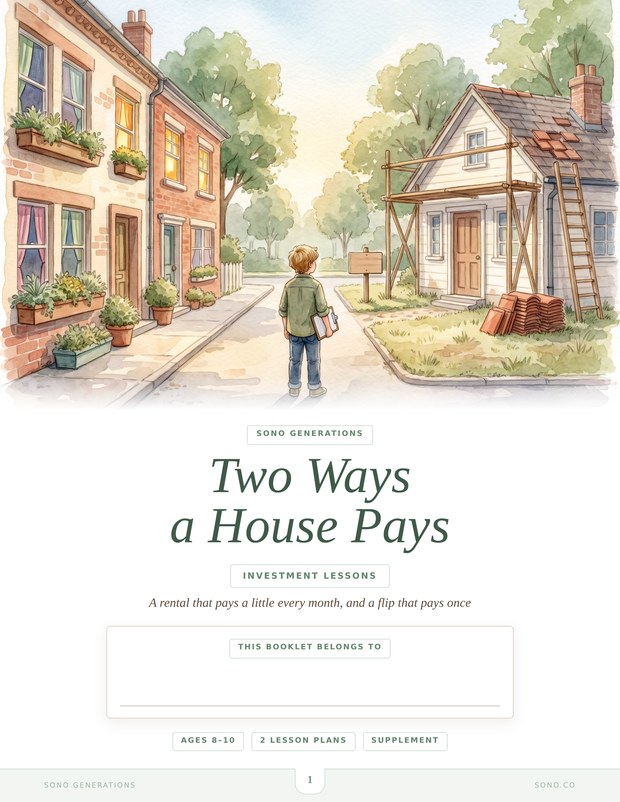
Two Ways a House Pays cover

Ages 8–10 · a supplement, not a fifth tier

Two Ways a House Pays

21 pages · two lesson plans, about forty minutes each · for families who already have Junior Builders

For the child who has finished Junior Builders and wants the next real thing. Lesson one is a rental: where every dollar of the rent actually goes, and what one empty month costs. Lesson two is a fix-and-flip, budget and all — including the flip that loses money, worked through to the end rather than left out.

Coming soon

Email me about these
Everything, together

A four-year-old who can tell you what equity is.

All four workbooks · seven years of it, in one download

  • Tiny, Little, Growing and Junior Builders, complete
  • The Biblical Stewardship appendix, also supplied on its own
  • Both open-house pages at three reading levels
  • Licensed for your whole family — print every page as often as you like
  • Free updates to every edition, for as long as there are editions
Email me when all four land

Instant download · No account to create · thirty days to change your mind, once there is something to change it about

Questions

Before you decide.

What exactly do I get?

A PDF. When they go on sale it arrives immediately, by email and on the confirmation page; today the only file you can have is the free Little House Tour page. Letter size, 8.5 × 11 inches, designed to print at home on an ordinary printer. Nothing physical is shipped and nothing arrives in the post.

We homeschool already. How does this fit?

It is a mini curriculum, and the word doing the work there is mini. Ten ideas, a page or two each, with a scope and sequence you could read in a minute — and no unit tests, nothing to grade, and no pacing guide to fall behind on. It sits alongside whatever you already run rather than asking for a slot; most families do one page in a sitting and then go and look at a real house. And if you left because the system trains the wrong instincts, be warned that most of what is sold to homeschoolers was written by people who left the classroom and took the syllabus with them. This is the piece those boxes still do not cover, because they were built from the same template by the same kind of person.

Isn't three too young for any of this?

Too young for mortgages, certainly, which is why Tiny Builders never mentions one. What a three-year-old can hold is much smaller: this is a home, homes cost money, here is a jar with three coins in it, and here is a bush with more berries on it this year than last. That is the whole lesson at that age. It is also the foundation the other three workbooks are built on top of, which is why it is worth laying properly rather than waiting until somebody is old enough for the interesting version.

The waiting is a school habit, incidentally — the assumption that every subject has a year it belongs to and that arriving early is a kind of error. Nobody holds off on weather, or animals, or where food comes from, until a syllabus gives permission.

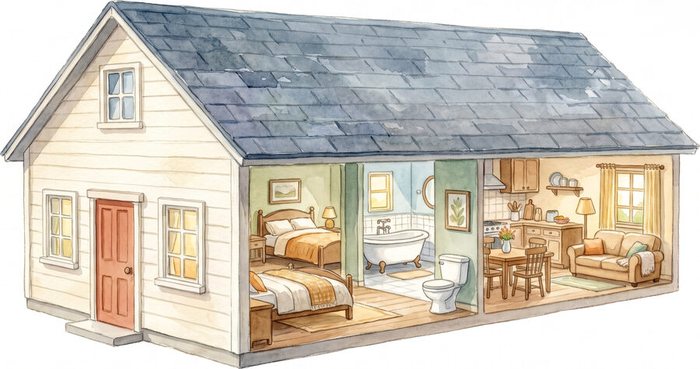
Watercolour cutaway of a house showing every room inside The launch list

Be told the day they open.

One email, on launch day. Unsubscribe in a click.

Instant PDF download · print as often as you like · thirty days to change your mind once they're on sale